Why Sparrows Are Disappearing from Indian Cities - And What You Can Do About It

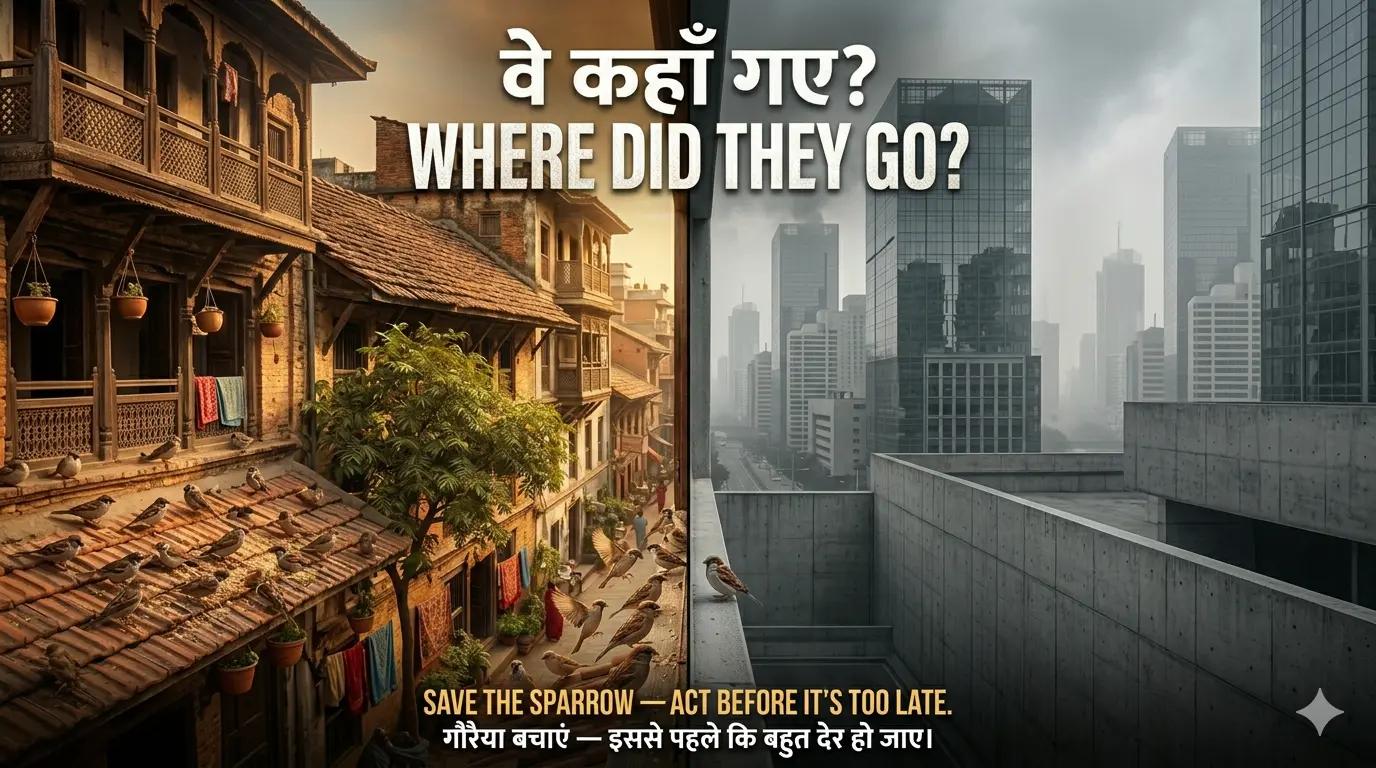
Bring the sparrows back - starting with your own balcony! Shop BirdKart's curated range of sparrow-friendly nest boxes, natural bird feeders, and wild bird food trusted by bird lovers across India. 🐦 Shop Now at BirdKart.com →
Do you remember the sound of sparrows chirping outside your window in the morning? That familiar, cheerful twitter that once marked the start of every day across Indian homes - whether in a Delhi colony, a Mumbai chawl, or a quiet lane in Jaipur. For most of us, that sound has slowly, almost silently, faded away.
The house sparrow (Passer domesticus), once one of the most commonly spotted birds in Indian cities, is now fighting for survival in urban India. Their numbers have dropped so sharply that the International Union for Conservation of Nature (IUCN) has listed the house sparrow under the "Least Concern" category globally - but urban India tells a very different story. In cities like Delhi, Mumbai, Chennai, and Bengaluru, local sparrow populations have crashed by over 60% in the past two decades.
This is not just a wildlife problem. It is a signal - a warning from nature that something is deeply broken in the way we have built our cities.
Let's understand why sparrows are disappearing, and more importantly, what each one of us can do to help.
The House Sparrow in India: A Brief Context
The house sparrow has lived alongside humans in India for thousands of years. It is a commensal species, meaning it evolved to thrive in proximity to human settlements. Our homes provided nesting spaces - gaps under roof tiles, ledges, holes in old walls. Our kitchens and grain stores provided food. Our gardens and open spaces provided insects for their chicks.
For centuries, this relationship was mutually beneficial and balanced. But rapid urban development over the last three to four decades has completely transformed India's cities - and the sparrow has paid a steep price.
"In every walk with nature, one receives far more than he seeks."
That wisdom feels especially true when we notice what we've lost. The absence of sparrows is nature telling us that our urban environment has become inhospitable - not just for birds, but increasingly, for us too.
6 Key Reasons Sparrows Are Disappearing from Indian Cities
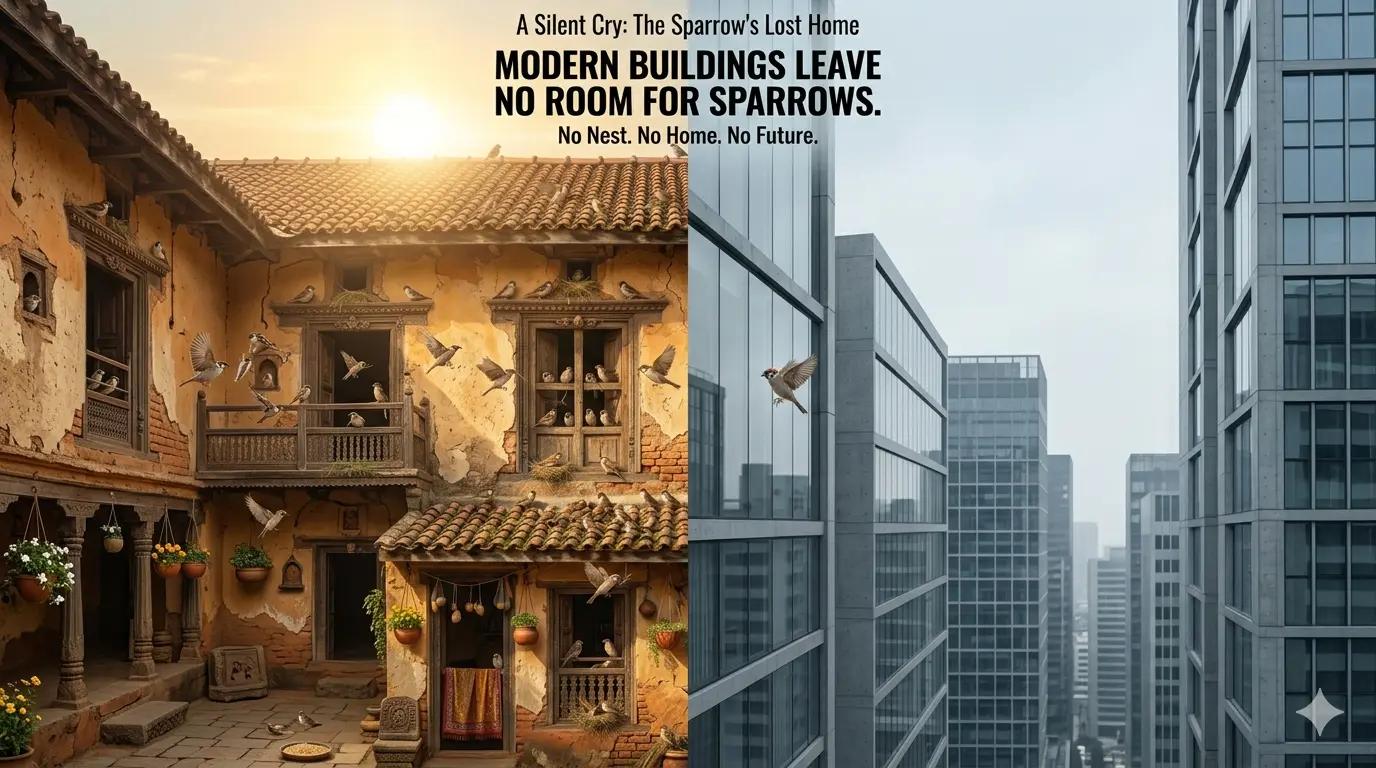
1. Loss of Nesting Spaces Due to Modern Architecture
Traditional Indian homes - with their clay roof tiles, broken plaster walls, and open attics - were perfect sparrow habitats. Modern construction, however, leaves no room for birds. Smooth glass facades, sealed RCC buildings, and concrete apartment complexes offer zero nesting opportunities for a sparrow looking to raise a family.
The shift from kaccha and semi-pucca homes to modern high-rise buildings has eliminated millions of nesting cavities across Indian cities. Without safe places to nest and breed, sparrow populations simply cannot sustain themselves.
2. Disappearance of Native Plants and Green Spaces
Sparrows don't just need shelter - they need food. And not just any food. Adult sparrows feed on seeds, but their chicks depend heavily on soft-bodied insects, particularly caterpillars and aphids found on native plants, during the first few weeks of life.
As cities replace native trees and shrubs with ornamental exotic plants and concrete parks, the insect population crashes - and the sparrows have nothing left to feed their young. Urban "beautification" projects that remove traditional trees like neem, peepal, and berry-bearing shrubs have had a devastating effect on urban bird food chains.
3. Rampant Use of Pesticides and Insecticides
The use of chemical pesticides in urban and peri-urban agriculture, parks, and gardens has sharply reduced the availability of insects that sparrows and their chicks depend on. This is part of a broader phenomenon being studied globally - often called "insect apocalypse" - where insect populations are declining at alarming rates due to chemical exposure.
When sparrow chicks cannot get enough protein-rich insects in their first two weeks of life, survival rates drop dramatically. Entire breeding seasons can fail silently, without anyone noticing until the population has already collapsed.
4. Electromagnetic Radiation from Mobile Towers
This is one of the more controversial - but increasingly researched - factors behind house sparrow decline in urban India. A growing body of scientific work, including studies from Spain and India, suggests that electromagnetic radiation (EMR) from mobile phone towers and dense Wi-Fi networks may interfere with sparrow navigation, fertility, and egg-hatching success.
While more research is needed to draw definitive conclusions, many ornithologists in India, including those from the Salim Ali Centre for Ornithology and Natural History (SACON), have noted correlations between high tower density and low sparrow sightings in certain urban zones.
5. Food Scarcity - Lack of Grain and Open Kitchens
Traditional Indian households had open kitchens, outdoor grain storage, and vegetable gardens. Sparrows scavenged grains that fell naturally during food preparation or storage - bajra, jowar, rice, wheat. Modern homes with modular kitchens, packaged food, and sealed storage leave nothing for sparrows to forage.
This change in domestic food culture, while perfectly logical from a human standpoint, has removed a primary food source that sparrows depended on for centuries in the Indian subcontinent.
6. Predation, Cats, and Urban Stress
Free-roaming urban cats, an increase in crows and kites in garbage-rich cities, and general urban stress (noise, light pollution, air pollution) all add pressure on small birds like sparrows. Studies have shown that chronic exposure to urban noise disrupts sparrow communication - they struggle to find mates, defend territory, and coordinate nesting.
Light pollution, increasingly severe in Indian metros, disrupts circadian rhythms and seasonal breeding cues. Sparrows that nest in well-lit areas often begin breeding at the wrong time of year, reducing chick survival.
What Is Being Done? Conservation Efforts in India
World Sparrow Day, observed every year on 20th March, was actually founded by Indian nature conservationist Mohammed Dilawar of the Nature Forever Society - a testament to how seriously India takes this crisis. His work earned him the Time Magazine Hero of the Environment award.
Several Indian cities have launched awareness campaigns, urban tree plantation drives, and community nest box programmes. Mumbai's BNHS (Bombay Natural History Society), Delhi's various nature clubs, and state forest departments have all run sparrow conservation initiatives at different points.
But awareness alone isn't enough. Real change happens at the individual level - in homes, on balconies, in societies.
"What we are doing to the forests of the world is but a mirror reflection of what we are doing to ourselves and to one another." - Mahatma Gandhi
This holds especially true for the crisis of urban sparrows. Our concrete cities are simply mirroring the disconnect we've created between modern living and the natural world.
What You Can Do: Practical Steps to Help Sparrows
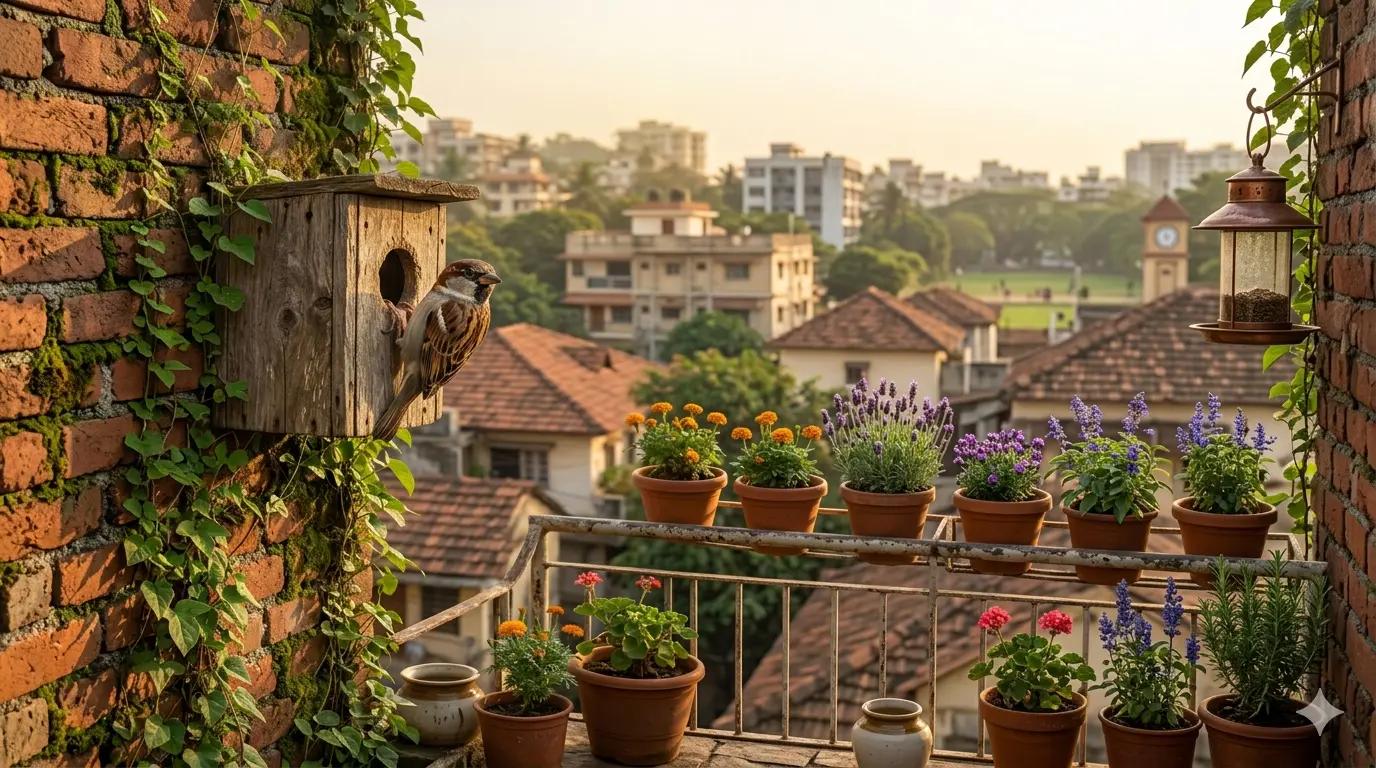
You don't need to be a wildlife expert or a forest ranger to make a difference. Here is what you - right now, from your home - can do to help bring sparrows back.
1. Put Up a Sparrow Nest Box
Sparrows are cavity nesters. A simple wooden nest box with an entry hole of 32mm diameter, placed 2–3 metres above ground on a wall or balcony railing, is often all it takes to invite a nesting pair. Avoid placing it where cats or crows can easily access it.
👉 Explore BirdKart's range of sparrow nest boxes and bird houses →
2. Set Up a Bird Feeder with the Right Food
Fill a quality bird feeder with small grains - millet (bajra), broken rice, or canary seed - and place it in a quiet, sheltered spot. Clean the feeder regularly to prevent fungal growth. Consistency is key: once sparrows find your feeder, they'll return daily if the food is reliable.
3. Provide Fresh Water Year-Round
A shallow bird bath or even a small clay dish with fresh water can be a lifesaver - especially during Delhi's brutal summers or Chennai's dry months. Keep it in a place with some overhead cover to make birds feel safe from predators.
4. Plant Native Species in Your Garden or Balcony
Even in a small balcony, growing native plants like tulsi, mogra, curry leaf, or small berry-bearing plants can attract the insects sparrows need to feed their chicks. Say no to synthetic pesticides in your garden - opt for neem-based or organic alternatives.
5. Spread Awareness in Your Housing Society
Talk to your RWA or housing society. Propose:
- A community nest box installation on the building's exterior walls
- No-pesticide zones in society gardens
- Native tree plantation in open areas
Small collective actions at the society level can create large, meaningful habitat patches for urban birds.
6. Record and Report Sparrow Sightings
Join citizen science platforms like eBird India or the India Biodiversity Portal and log your sparrow sightings. This data helps researchers track population trends and plan conservation efforts more effectively. You don't need expertise - just a phone and a pair of eyes.
Why This Matters Beyond Just Sparrows
The decline of the house sparrow is what ecologists call a "canary in the coal mine" moment for urban biodiversity. Sparrows are not just cute birds - they are keystone indicators of urban ecosystem health. Their disappearance signals collapsed insect populations, degraded green cover, chemical-laden soils, and broken food webs.
Cities that lose their sparrows are cities that are slowly losing their capacity to support life at the base of the ecological pyramid. And when that happens, human health - from air quality to mental wellbeing - suffers too.
Protecting sparrows is not about sentiment alone. It is about choosing what kind of cities we want to live in.
Final Thoughts
The return of the sparrow to Indian cities is possible - but it requires intentional, collective action. Every nest box matters. Every feeder matters. Every balcony garden matters. Every person who chooses to see their home as part of a living ecosystem matters.

Written by BirdKart
Sharing expert tips on bird homes, balcony birding, and nature-friendly living. We create practical guides, care tips, and product insights to help bird lovers choose the perfect bird homes and handcrafted water clay bowls for their outdoor spaces.