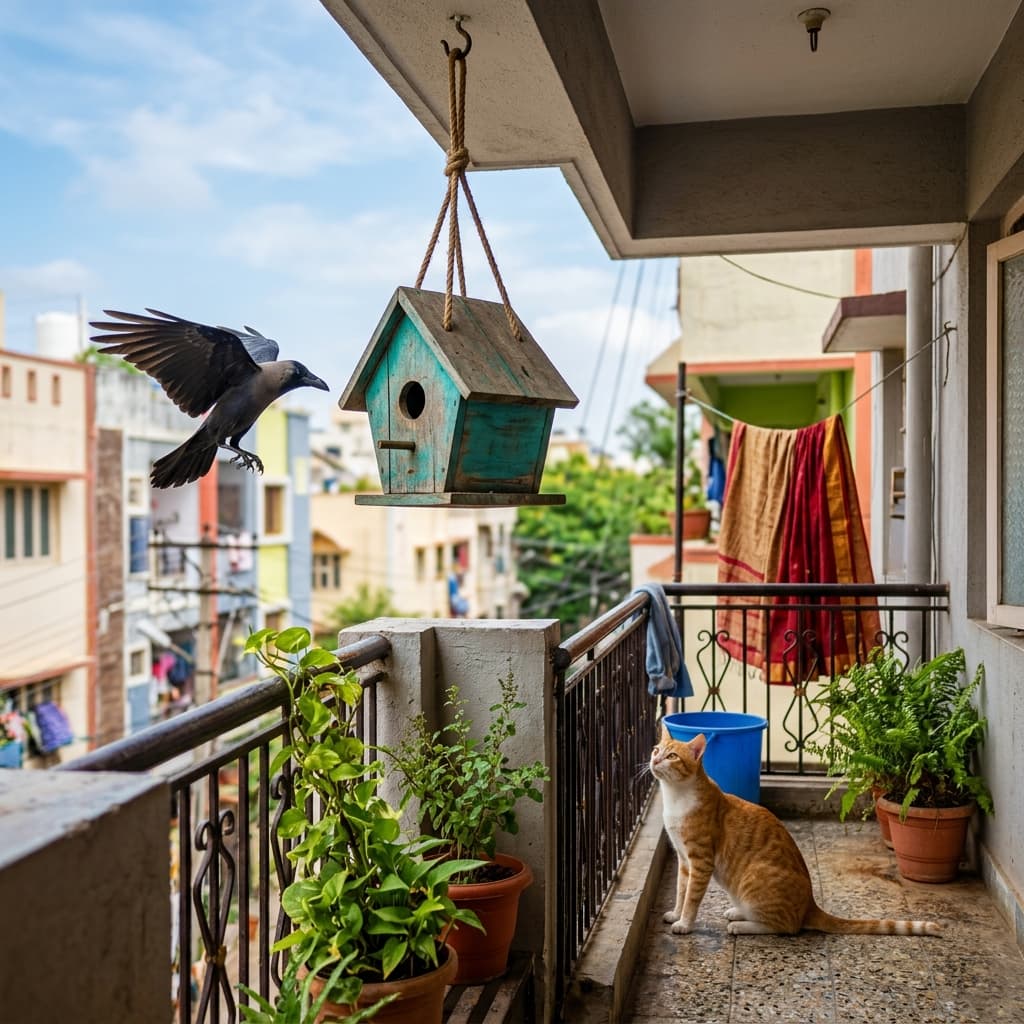
You spent time choosing the right birdhouse. You hung it carefully, filled the feeder, kept fresh water nearby. And then a crow landed on the roof. Or the neighbourhood stray cat started eyeing your balcony every morning.
This is one of the most frustrating experiences for bird lovers in India, and it is far more common than most guides acknowledge. Protecting a birdhouse in an Indian urban setting is genuinely different from what works in Western countries. We do not have raccoons or squirrels raiding our nest boxes. We have house crows, arguably the most intelligent and persistent nest predators in any city and we have millions of stray cats that roam freely through apartment complexes, terraces, and building corridors.
If you want to know how to protect your birdhouse from predators in India, this guide is written specifically for your situation. No generic Western advice, no products unavailable here, just practical solutions that work in Indian apartments, balconies, and homes.
Why Crow and Cat Attacks Are So Common in Indian Cities
Before getting into solutions, it helps to understand why this problem is so severe in India specifically.
The Indian house crow (Corvus splendens) is not just opportunistic, it is systematic. Crows in Indian cities have lived alongside humans for centuries and have become extraordinarily good at identifying food sources, including nesting birds. They recognise a birdhouse within days of it being installed. They will wait patiently on a nearby ledge, observe the nesting pair's routine, and strike the moment the adult birds leave the nest unattended.
Crows do not just steal eggs. They will attack adult sparrows, destroy nesting material, and return to the same birdhouse repeatedly once they have identified it as a food source.
Cats present a different kind of threat. In Indian cities, stray cats are everywhere and unlike pet cats in Western countries that are typically kept indoors, Indian strays have developed sharp survival instincts. They are excellent climbers, completely comfortable on balcony grills, railings, and narrow ledges, and they are most active at dawn exactly when sparrows and other small birds are feeding and most vulnerable.
Understanding these two very different threats is key to building an effective defence strategy.
Part 1 — How to Protect Your Birdhouse from Crows in India
Crows are smart enough that a single solution rarely works permanently. The most effective approach combines physical design changes with smart placement.
Use a Birdhouse with the Correct Entry Hole Size
This is your first and most important line of defence. A house crow cannot fit through an entry hole smaller than 4.5 to 5 cm. A sparrow needs only 3.2 to 3.5 cm.
If your birdhouse has a large or unspecified entry hole, replace it or add a metal entry hole restrictor — a flat metal plate with the correct diameter hole that fits over the existing opening. This single change eliminates the possibility of a crow entering the nest box entirely.
Even if a crow cannot enter, however, it can still reach inside with its beak. This is where the next measure becomes critical.
Add an Entry Hole Extender or Tunnel
An entry hole extender is a short wooden or metal tube — typically 5 to 8 cm long — fitted around the entry hole of the birdhouse. It creates a tunnel effect that makes it physically impossible for a crow to reach the eggs or chicks inside, even with its beak extended.
You can buy these as predator guards or make one at home using a section of PVC pipe cut to the right diameter and glued securely around the entry hole. For sparrows, the internal diameter should remain 3.2 to 3.5 cm.
This is one of the most effective and low-cost birdhouse predator guard solutions available in India and works specifically against the reaching-in behaviour that Indian house crows are known for.
Extend the Roof Overhang
A standard birdhouse roof sits close to the front of the box. Crows and larger birds exploit this by perching on the roof and reaching down to the entry hole.
A roof overhang of at least 10 to 12 cm beyond the front face of the birdhouse makes this significantly harder. It prevents a crow from getting stable footing above the entry hole and limits the angle at which it can reach downward.
If your existing birdhouse has a short roof, you can attach an additional piece of treated wood or a flat slate tile to extend it. Secure it firmly — crows are heavy birds and will test the stability of anything they land on.
Place the Birdhouse Away from Crow Perching Points
Crows always launch their attack from a nearby perch. On Indian balconies and building exteriors, these perches are typically:
- Overhead cables and wires
- Nearby window ledges and AC unit frames
- Balcony railings and grills
- Branches of trees adjacent to the building
Map out where crows typically perch near your balcony before deciding where to hang your birdhouse. Ideally, position the birdhouse so that the entry hole faces a direction where there is no obvious perching point within 3 to 4 metres.
A hanging birdhouse suspended from the centre of a balcony ceiling — away from walls and railings — is much harder for a crow to access than one fixed directly to a wall.
Use Reflective Deterrents Near the Birdhouse
Crows are wary of unpredictable movement and reflections. Hanging strips of reflective material — old CDs, foil strips, or purpose-made reflective bird deterrent tape — within a metre or two of the birdhouse creates a visual disruption that makes crows uncomfortable.
This works best as a supporting measure rather than a standalone solution. Crows are intelligent and will eventually habituate to static reflective objects. Rotate or reposition the deterrents every few weeks to maintain their effectiveness.
Never Hang the Birdhouse Near a Crow Feeding Area
If you have a separate bird feeder, keep it at least 3 to 4 metres away from your birdhouse. Crow activity around feeders is very high — by keeping the nesting box away from feeding activity, you reduce the chances of crows even noticing it in the first place.
Part 2 — How to Keep Cats Away from Your Birdhouse
Cats require a completely different set of solutions. Unlike crows, which attack from above and at a distance, cats are climbers and ambush hunters. Their threat is most serious at ground level and on accessible railings.
Height Is Your Best Defence
The most reliable way to protect a birdhouse from cats on an Indian balcony is height. A birdhouse mounted or hung at 3 to 4 metres above the ground — near the ceiling of a balcony — is out of comfortable reach for most cats.
Cats can jump approximately 1.5 to 1.8 metres vertically from a standing position. From a running start or from a nearby ledge, they can cover more. If your birdhouse is within jumping distance of a balcony railing, a window ledge, or an AC unit, a determined cat can reach it.
Audit your balcony the way a cat would. Identify every surface that could serve as a launch point and either remove it or ensure the birdhouse is not within reach from that surface.
Use a Smooth Metal Pole or Hanging Setup
If you are mounting a birdhouse on a pole rather than hanging it, use a smooth metal pole that cats cannot grip while climbing. Round poles with a diameter of 3 to 5 cm in smooth steel or PVC are very difficult for cats to climb, especially if the pole has no horizontal features to grip.
For balcony ceiling hangers, ensure the hanging rope or chain is thin enough that a cat cannot wrap its paws around it, and that it hangs freely away from any wall or railing surface.
Install a Cone Baffle Below the Birdhouse
A cone baffle is a conical or dome-shaped guard fitted around a pole below the birdhouse. It flares outward so that a cat climbing up the pole hits the underside of the cone and cannot continue upward.
This is one of the most widely used birdhouse predator guard solutions internationally and works very well in Indian conditions. You can find metal cone baffles online in India or fashion one from a large plastic bowl or sheet of metal flashing cut and shaped into a cone.
The baffle should be at least 50 to 60 cm in diameter and positioned approximately 1.5 metres above the ground — high enough that a cat cannot jump past it from below.
Remove Surfaces Cats Use to Access Your Balcony
Stray cats enter Indian apartment balconies in several predictable ways — climbing drain pipes, jumping from adjacent balconies, or walking along shared ledges. If you can identify and reduce these entry points, you lower the overall risk significantly.
Smooth plastic pipe covers on drain pipes, railing extensions on open balcony sides, and closing off gaps in grill work are all practical measures. For apartment dwellers, even something as simple as placing thorny potted plants like cacti or bougainvillea along the top of the railing creates an uncomfortable surface that most cats will avoid.
Avoid Leaving Food Out After Feeding Hours
Leftover birdseed, grain, or water left out overnight attracts both stray cats and crows. Clear away unconsumed food before dusk. This reduces the reason for predators to visit your balcony in the first place and lowers the chance of them discovering your birdhouse through repeat visits.
Bird Nest Protection for Balcony Apartments — Special Considerations
Urban apartment dwellers face a unique set of constraints when it comes to bird nest protection. You cannot install large poles, build enclosures, or make structural changes to the building. Here is what works specifically in an apartment balcony context in India.
- Ceiling suspension over wall mounting: A birdhouse hung from the ceiling of a covered balcony is safer than one fixed to the wall. It is harder for cats to reach, harder for crows to perch above, and positioned away from the edge where both predators typically approach from.
- Enclosed or semi-enclosed balconies: If your balcony has a grill enclosure, the grill itself provides a layer of protection. Ensure that gaps in the grill are smaller than 15 cm so that neither cats nor crows can pass through easily. Attach additional mesh or net if needed.
- Avoid the corner position: Many people naturally place birdhouses in balcony corners. Corners are actually the worst position for bird nest protection because they give predators a stable surface on two sides to approach from. A central hanging position is always safer.
- Consider a CCTV camera or motion sensor light: In areas with persistent crow attacks, a motion-sensor LED light positioned near the birdhouse can startle approaching birds after dark. Crows typically attack early morning — a sudden light stimulus disrupts their approach pattern effectively.
What to Do During Breeding Season (March to June)
Breeding season is when your birds are most vulnerable and when predator activity is highest. Crows instinctively know that nesting season means available eggs and chicks — their raids intensify significantly from March onward.
During this period:
- Check your birdhouse mounting and all predator guards at least once a week
- Avoid cleaning or disturbing the birdhouse once eggs have been laid
- Keep the feeding area clean and food-free after 6 PM
- Minimise your own balcony activity during the early morning hours (6 AM to 9 AM) when both sparrows are feeding their young and crows are most active
- If you observe a crow repeatedly attempting to access the birdhouse, temporarily hang additional reflective deterrents nearby for 7 to 10 days
Frequently Asked Questions
Can crows break into a wooden birdhouse in India?
A crow cannot break through solid wood, but it can reach inside through an oversized entry hole or by gripping the rim of the hole with its beak. Adding a metal entry hole plate and an entry hole extender removes this vulnerability entirely.
Are stray cats more dangerous than crows to nesting birds?
Both pose serious threats but in different ways. Crows are more persistent and will attack actively over multiple days. Cats are ambush hunters — a single successful attack can wipe out an entire nest in minutes. In apartment buildings with multiple stray cats, cats are often the more immediate danger.
Do reflective objects permanently deter crows?
No. Crows habituate to static deterrents within 1 to 2 weeks. Reflective strips and CDs work best when rotated, repositioned, or combined with other physical deterrents. Relying on reflective objects alone is not a long-term solution.
What is the best birdhouse predator guard for Indian conditions?
For crow protection — an entry hole extender combined with an extended roof overhang. For cat protection — a cone baffle on the pole combined with height positioning above 3 metres. Used together, these two measures address the most common attack patterns seen in Indian urban areas.
Will a sparrow abandon its nest if a crow attack?
Yes — if a crow successfully raids the nest even once, the sparrow pair will often abandon that box for the rest of the season. Preventing the first attack is far more effective than trying to restore the nesting pair's confidence after one has occurred.
My balcony is on the 8th floor. Do I still need predator protection?
Yes. Crows are comfortable at any building height and will investigate birdhouses on high floors regularly. Cats are less of a concern above the 5th or 6th floor unless your building has easy stair or ledge access, but crow protection remains essential regardless of floor level.
A Quick Checklist Before Breeding Season
Use this before March each year to make sure your birdhouse is fully protected:
- Entry hole size is 3.2 to 3.5 cm for sparrows — no larger
- Metal entry hole plate is fitted and secure
- Entry hole extender or tunnel is attached
- Roof overhang extends at least 10 cm beyond the front face
- Cone baffle is fitted below the box if pole-mounted
- Birdhouse is hanging at 3 metres or above
- No crow perching point within 3 to 4 metres of the entry hole
- Reflective deterrents are positioned and will be rotated every 2 weeks
- Balcony access points for cats have been assessed and addressed
- Leftover food is cleared before dusk every day
Final Thoughts
Protecting a birdhouse from crows and cats in India requires a combination of smart design choices, correct placement, and a bit of seasonal attention. There is no single product or trick that solves everything — but when you layer two or three of the solutions above, the results are genuinely effective.
The sparrows, bulbuls, and sunbirds visiting your balcony cannot speak for themselves. A birdhouse without proper protection is not much better than no birdhouse at all — it simply becomes a trap that exposes nesting birds to predators they have no way to escape.
Take the time to get the protection right. The reward is a nesting pair that returns to your balcony season after season, year after year.
If you are looking for a well-designed wooden birdhouse built with the right entry hole dimensions and predator-resistant features for Indian conditions — you are already in the right place.